
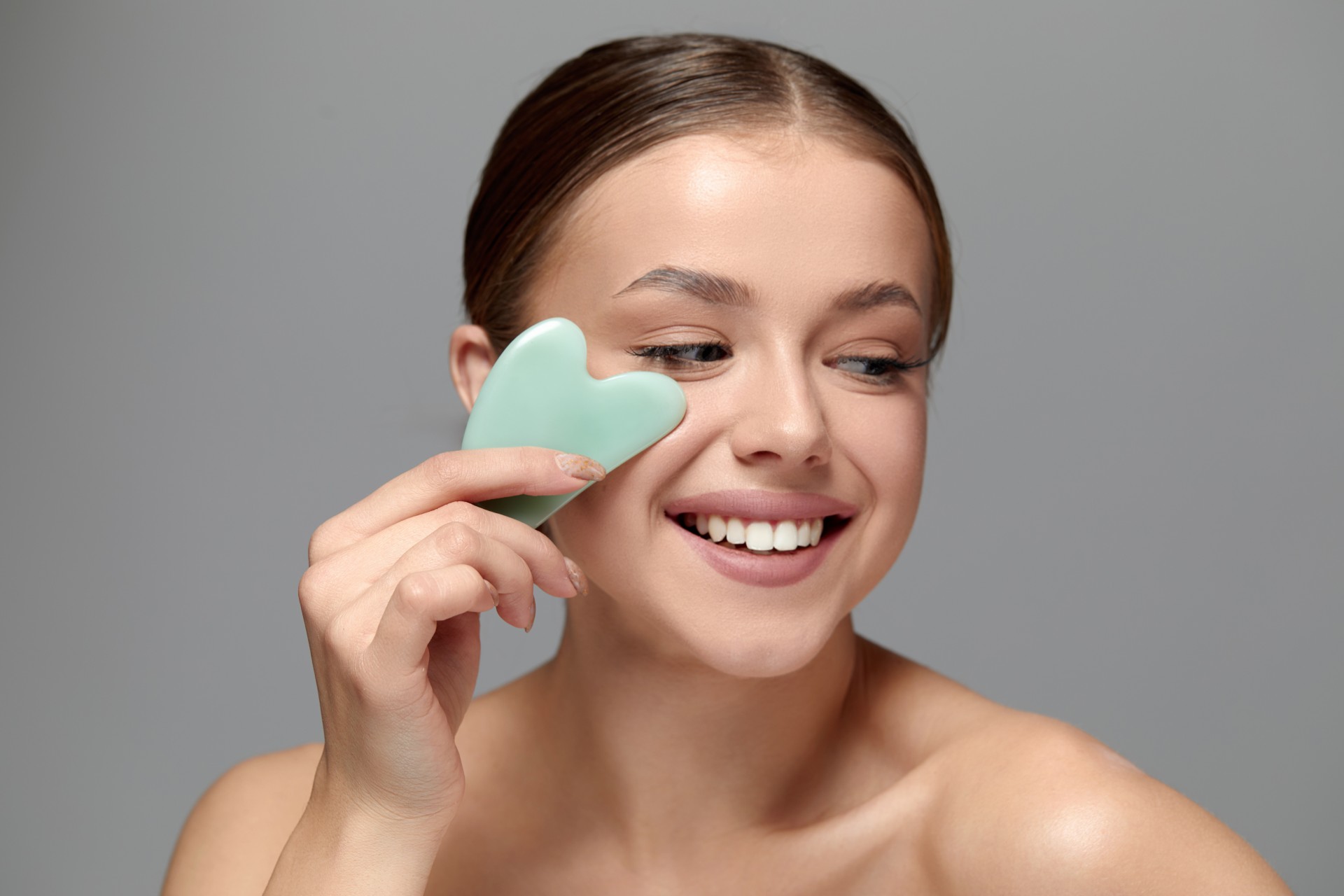
Gua sha: how to use it correctly for a more relaxed and sculpted face
Inspired by ancient Chinese beauty rituals, gua sha helps promote fluid drainage and reduce facial puffiness through gentle, targeted movements, complementing daily skincare and enhancing the skin’s natural appearance.
Just a few minutes and a handful of simple gestures are all it takes to turn your skincare routine into a moment dedicated to all-round well-being. It is no coincidence that, in recent years, gua sha stone massage has been winning over an increasing number of skincare enthusiasts around the world. This centuries-old technique has its origins in traditional Chinese medicine and involves using a specially shaped, ergonomic stone to follow the contours of the face with slow, gentle movements.
It is a practice that encourages you to slow down and pay greater attention to your needs, your sensations, and your connection with your body. At the same time, when performed correctly, gua sha massage can also offer certain aesthetic benefits. The gentle movements of the stone may help promote the drainage of superficial fluids, contributing to a reduction in facial puffiness, particularly around the eyes and cheekbones, where it is often more noticeable upon waking or after a sleepless night. With regular practice, the massage may also help the skin look smoother, and facial features appear more defined.
However, it is important not to expect miraculous results: the value of gua sha massage lies above all in the opportunity to incorporate a little self-care into your beauty routine, while potentially enhancing the effects of the skincare products you regularly use. But which stone should you choose, how should you use it correctly, and what precautions should you take to get the most out of the massage?
Facial gua sha: what are the benefits of stone massage?
A fresher-looking face, visibly more relaxed features, and a few minutes dedicated to yourself: these are some of the reasons why gua sha has become an increasingly popular part of beauty routines. Stone massage, performed through slow, gentle movements, is particularly appreciated for its ability to temporarily reduce puffiness and provide a pleasant feeling of lightness.
The effect can be particularly noticeable in the morning, when fluid retention can make the face look puffier, especially around the cheeks and eyes. Results vary from person to person, but the correct technique can make using a gua sha stone, ideally combined with a periocular massage, an interesting addition to daily skincare.
In addition to helping temporarily reduce puffiness, gua sha massage may help make facial contours appear more defined. By gliding the stone along the jawline and cheekbones with light, consistent pressure, you gently guide the movement of the tissues without putting stress on the skin. The aim is not to change the shape of the face, but to achieve a temporary smoothing effect, which may be more noticeable when mild puffiness is present.
There is also the pleasure of turning an everyday gesture into a little moment of well-being. The repeated, controlled movements encourage you to slow down and devote a few minutes to self-care, either in the morning or in the evening. To help the stone glide smoothly, it is always advisable to apply a facial serum or oil beforehand, avoiding massage on dry skin.
The massage is also often associated with brighter, more rested-looking skin. After the treatment, the complexion may temporarily appear fresher, but it is important to remember that radiance depends on several factors, including hydration and the condition of the skin barrier. For this reason, gua sha works best when incorporated into a complete routine that includes gentle cleansing, moisturising products suited to your skin and the daily application of broad-spectrum sun protection capable of blocking both UVA and UVB rays.
When it comes to treating the first signs of ageing, however, it is important to distinguish between realistically achievable benefits and unrealistic expectations. There is no solid evidence that facial gua sha eliminates wrinkles, significantly stimulates collagen production, or permanently reshapes facial features. Any reduction in puffiness may also be temporary and varies from person to person. For lasting improvements in skin quality, massage should therefore be considered a complement to good facial skincare habits, rather than a substitute for dermatological or cosmetic treatments with documented effectiveness.
Gua sha stone: materials, shapes and tips for choosing the right one
The gua sha stone is the central element of the ritual. Usually made from jade, rose quartz, metal, or wood, it has a curved shape that allows it to follow the contours of the face and easily reach areas such as the jawline, cheeks, and forehead. Different models are available on the market, varying in material, size and design, and intended to suit personal preferences and different massage needs.
The choice of material depends mainly on the sensations you wish to experience during the treatment and the practicality of the tool. Jade and rose quartz are among the most widely used stones: both can provide a smooth surface that feels pleasant against the skin. Jade is traditionally associated with balance and well-being, while rose quartz is particularly appreciated for its delicate colour. These associations belong to the traditions and imagery surrounding beauty rituals, but there is insufficient scientific evidence to claim that either stone is more effective than the other or possesses specific anti-ageing properties.
Alongside natural stones, there are tools made from stainless steel and other metals, appreciated for their durability and ease of cleaning, provided that their surfaces are intact and suitable for contact with the skin. Metal tends to feel noticeably cooler than other materials and can be particularly pleasant when the face appears puffy upon waking. Another alternative is wood, which offers a warmer sensation and is often lightweight and comfortable to hold. In this case, it is important to choose a well-polished, splinter-free and properly treated tool, as some types of wood can be more difficult to clean and dry than non-porous surfaces.
Shape also deserves attention. Models with a double curve, often resembling a heart, are versatile and allow the stone to adapt to different areas of the face. More elongated versions can be practical for following the cheeks and forehead, while tighter curves help when working along the jawline and near the cheekbones. Models with wavy edges or grooves are also available, but for the face it is preferable to choose smooth, well-finished surfaces, avoiding protrusions that could scratch or irritate the skin.
The choice, therefore, should not be based solely on colour or material, but above all on the quality of the workmanship, how comfortable the tool is to hold and its ability to glide easily over the skin. Smooth edges, the absence of cracks, and a shape suited to your hands are more important features than the cosmetic promises associated with a particular stone.
The temperature of the gua sha tool can also contribute to making the experience more or less pleasant. A stone that feels cool against the skin provides a sensation that can be particularly welcome when the face appears puffy. Cold can, in fact, help temporarily ease the feeling of puffiness, but there is no evidence that a specific temperature makes the massage more effective in the long term. If the material allows it, the tool can be placed briefly in the refrigerator, while the freezer and extreme temperature changes should be avoided, as they could damage certain stones. In any case, the sensation should always be comfortable: if contact causes discomfort, burning, or pain, it is best to stop the massage.
How to clean and store your gua sha stone
Cleaning the tool is an important step in maintaining proper hygiene during your beauty routine. Before and after each use, it is advisable to check that the surface is clean and free from cosmetic residue. After the massage, the stone can be washed with water and a gentle cleanser compatible with the material, always following the manufacturer’s instructions. It is important to dry it thoroughly before putting it away, especially if it has curves or grooves where moisture could accumulate.
Proper storage also helps keep the tool in good condition. It is preferable to store it in a clean, dry case, avoiding contact with objects that could chip it or scratch its surface. Before each massage, it is worth checking for cracks, chips or imperfections along the edges: a damaged stone could irritate the skin and should be replaced.
How to use your gua sha: the steps for an effective facial massage
Incorporating gua sha into your beauty routine does not require complex techniques, but rather a few precautions to perform the massage correctly. The stone should glide over the skin with slow, fluid movements, following the contours of the face and maintaining light pressure. The aim is to guide the movement of the tool without pulling the skin or causing persistent redness.
One of the most important aspects concerns the direction of the massage. Movements are generally performed from the centre of the face outwards and, in some sequences, from the lower part of the face upwards. This method is used in gua sha routines to follow the contours of the face and promote the drainage of superficial fluids.
1. Prepare the skin
Before starting, it is important to cleanse your face thoroughly to remove makeup, sebum and impurities. You can then apply a facial oil, a serum with a suitable texture or a cream that helps the stone glide smoothly. The product should be compatible with your skin type and allow the tool to move without friction. Finally, it is essential to avoid using gua sha on dry skin, as rubbing could cause irritation.
2. Hold the stone correctly
Hold the gua sha tool comfortably in your hand and place its rounded edge against the skin, keeping the tool almost parallel to your face. There is no need to apply much pressure: light, consistent contact is sufficient to perform the massage. If you feel pain or notice pronounced redness, it is important to reduce the pressure or stop the treatment.
3. Start at the jawline
You can now begin the massage at the jawline, placing the curved part of the stone on your chin and slowly gliding it along the outline of your face towards your ear. This direction allows you to follow the lower contour of the face and gently massage the tissues. Repeat the movement 5–10 times on each side.
4. Move on to the cheeks
Position the stone near the side of the nose and guide it outwards towards the cheekbones and temples, using steady movements and even pressure that can be adjusted according to your skin’s sensitivity. Once again, it is essential to take care not to drag the tool with excessive force: the massage should feel pleasant and should not leave visible marks.
5. Massage the forehead
Starting from the centre of the forehead, glide the stone towards the temples and hairline, following the natural shape of the upper third of the face and always maintaining gentle contact with the skin. A few controlled strokes are sufficient in this area too: increasing the pressure does not necessarily lead to better results.
6. Take care around the eyes
The skin around the eyes is thinner and more delicate than in other areas of the face. If you wish to massage it, you must use minimal pressure, with slow movements, without getting too close to the eyeball, avoiding passing the gua sha tool over the movable eyelid and stopping the massage if you experience discomfort, watering eyes or redness.
7. Finish with gentle movements
Once the massage is complete, you can allow the applied product to absorb or continue with the other steps of your skincare routine. There is no need to rinse your face unless the product used requires it. After the treatment, clean the stone according to the manufacturer’s instructions and store it in a clean, dry place.
Facial gua sha: frequently asked questions
1. How long should a gua sha massage last?
To begin with, around five minutes may be enough, dedicating a few strokes to each area of the face. There is no ideal duration that suits everyone: it is preferable to proceed according to your skin’s sensitivity and stop the treatment if it shows signs of irritation. The frequency can also be adapted to individual needs; practising it every day is not essential for everyone, and applying greater pressure does not make the massage more effective.
2. Does gua sha really help drain fluids?
Gua sha is often described as a draining massage because its gentle movements may temporarily encourage the movement of superficial fluids and help reduce puffiness. However, it is not accurate to talk about points that need to be unblocked or toxins that need to be eliminated: stone massage is not equivalent to a lymphatic drainage technique performed by a qualified professional. Any effects on puffiness may be temporary and vary from person to person.
3. When is it best to avoid gua sha?
The massage should not be performed on wounds, burns, active irritation or inflamed areas. In cases of rosacea, inflammatory acne, particularly sensitive skin, or conditions that increase the risk of bleeding, and bruising, it is advisable to consult a dermatologist before using the stone. The same caution is recommended after recent aesthetic or dermatological procedures, when the skin may need time to recover.
The fundamental rule is always to “listen” to your skin: the gua sha ritual should be pleasant, not something to be performed at all costs. Light pressure, a clean tool, and proper skin preparation are the most important precautions for incorporating it mindfully into your routine.
The Cure Therapy at Doglio Club: a ritual dedicated to facial care
Gua sha massage is a ritual that can easily be incorporated into daily skincare. However, enhancing your natural beauty also means placing yourself in expert hands and choosing treatments designed to meet more specific needs. At Palazzo Doglio, in the heart of Cagliari, the Doglio Club Mindfulness Spa offers a space dedicated to well-being, where you can take a relaxing break from your daily routine and learn how to care for your skin in a targeted and effective way.
Among the facial treatments on offer is The Cure Therapy, a treatment developed in collaboration with the cosmetics brand Natura Bissé, particularly appreciated for its detoxifying, moisturising and soothing action, which perfectly complements the draining and sculpting effects of gua sha. The Spa’s offerings also include The Citrus Essence, a treatment that harnesses the antioxidant and revitalising properties of vitamin C extracts, particularly suitable for restoring radiance and vitality to the skin after exposure to the sun and the environmental factors typical of the summer months, and The 3D Collagen Shock, which combines the hydration and radiance provided by collagen and elastin with antioxidant vitamins to nourish and revitalise the skin.
The Cure Therapy treatment lasts approximately 60 minutes and costs a total of 130 euros. To make a reservation, you can call 070-64-64-156 or send an email to club@palazzodoglio.com.
Would you like to discover the benefits of gua sha stone massage and enjoy a holiday filled with elegance and charm? Book a stay at Palazzo Doglio in Cagliari

